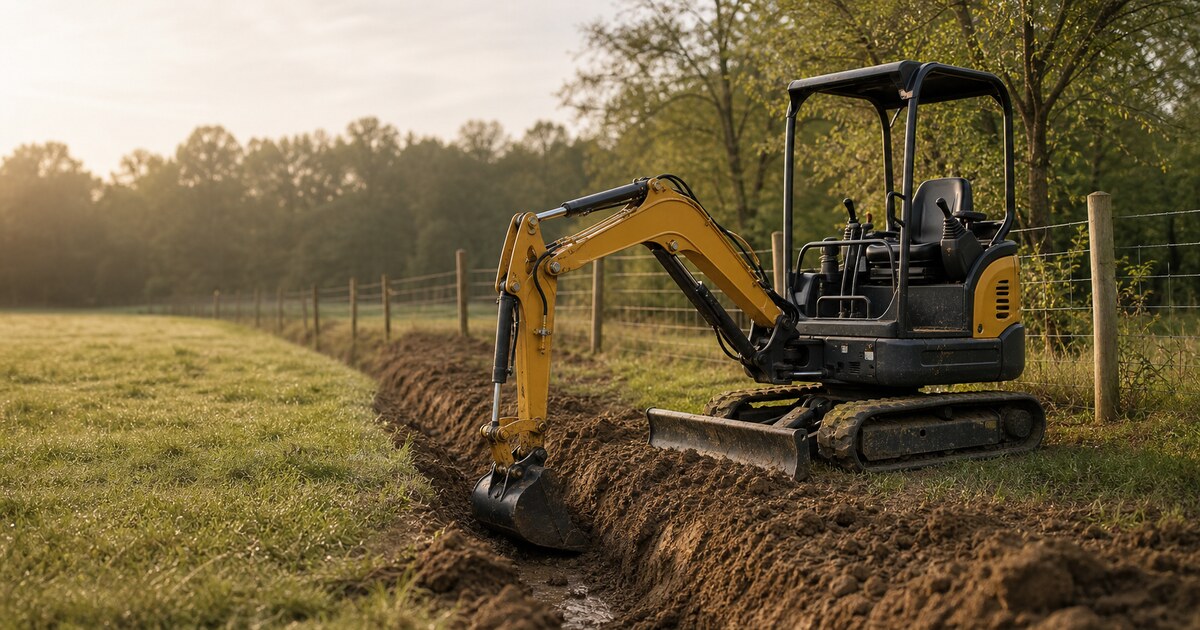
One name, many machines
“Chinese mini excavator” is a market category, not one design.
Machines with similar paint, body panels or model codes can use different engines, pumps, valves, travel motors, controls, track systems and fabrication. A positive report about one machine cannot erase a failure on another, and one failure cannot define the category.
The useful question is narrower: what work did the exact owner complete, for how long, with which configuration, and what support or repair burden came with it?
01 · Capability
Owners used them for real work—not only demonstrations.
The retained reports include plumbing rough-ins, landscaping jobs, drainage, culverts, water troughs, barn piers, orchard planting, trails, garden beds, rocks, shallow trenches and property cleanup.
They are strongest against hand labour
A small excavator can transform work that would otherwise require a shovel, wheelbarrow and several people. Owners repeatedly valued availability: the machine was already on the property when a short trench, drainage repair or cleanup task appeared.
Access can matter more than raw output
Sub-1.5-ton machines fit gates, side passages and tight yards that exclude a larger rental. That advantage disappears if the working stance is too narrow, the route crosses a soft shoulder or the machine cannot safely dump where the material needs to go.
The class has hard limits
Shallow reach, low mass, narrow tracks and modest hydraulic systems reduce production in hard clay, embedded rock, large roots and repeated deep digging. A two-year owner of a 1.2-ton machine moved up because a house build, retaining walls and compacted clay exceeded its useful work envelope.
Decision rule: Choose the machine for a measured recurring work cycle, not because the low price makes every future job look possible.
02 · Exposure matters
Four owner reports that explain the range of outcomes.
These cases do not create a failure rate. Together, they show why useful digging performance and demanding ownership can exist at the same time.
About 100 hard hours in a plumbing business
A roughly 2,000 lb petrol machine was used for foundation rough-ins and intermittent plumbing work. The owner reported no failures and substantial labour savings, but also described heat at the seat and limited safety equipment. He did not present it as an all-day production substitute.
More than 800 hours in landscaping
A 1.2-ton Briggs-powered machine reportedly worked for more than two years. The owners replaced or repaired a throttle cable, hour meter and starter-related component, accepted jerky travel and weak support, and still considered the machine valuable. One long-running machine does not establish a fleet failure rate.
More than 400 hours of homestead work
A Reddit owner described drainage trenches, garden beds, shelter cleaning, orchard planting, bales and neighbour septic work with no major issue reported. The exact model and maintenance history were not provided, so the account supports possibility—not a category promise.
Three years with a HIGHTOP HT10
The owner kept the machine useful through carburetor, coil, hose, seat, hinge, track, meter, fastener and corrosion work. He would not repeat the purchase for a business because repair time stops revenue. That distinction is central: tolerable property downtime can be unacceptable commercial downtime.
03 · Across independent owners
What consistently repeats.
A recurring theme is more useful than one dramatic success or failure. The repeated patterns below appeared across different machines, owners and jobs.
They replace a great deal of hand work
Owners used small Chinese excavators for drainage, shallow trenches, culverts, fencing preparation, landscaping, trails, rocks, garden work, barn projects and general property cleanup. The machines were most convincing when the work was recurring, access was tight and speed mattered less than having a digger available.
The owner becomes the first service department
Fluid changes, grease checks, track adjustment, fastener inspection, hose and fitting work, cable replacement and minor electrical repairs appeared repeatedly. Buyers who could diagnose and repair basic machinery described the work as manageable. The same faults would be much more disruptive for an owner dependent on immediate dealer labour.
Controls can be abrupt or less refined
Several operators described stiff or jerky controls, travel that responds better to decisive input, and weak simultaneous-function behaviour. They still completed useful work, but careful feathering and operator adaptation were part of the experience.
Cooling deserves configuration-specific attention
Heat below the seat, hot hydraulic fluid and owner-added cooling appeared in different machines and climates. That does not establish one category-wide overheating defect. It does justify checking the exact cooler, filtration, airflow, fluid specification and hot-cycle performance before long attachment work.
Fasteners, joints and tracks need an early baseline
Loose fasteners, a missing grease point, a seized bushing, a broken pedestal weld and track-tension problems appeared across independent reports. The practical response is an arrival inspection and planned recheck—not the claim that every machine has a structural problem.
Support varies more than the machine category suggests
One Rippa owner received a replacement swing motor under warranty. Other owners described weak parts lists, slow replies or self-sourcing common components. Brand, dealer, country and exact component identity change the recovery path, so support cannot be inferred from the words “Chinese mini excavator.”
04 · Reliability
The evidence supports a fit decision—not a category score.
The owner reports are too varied to call Chinese mini excavators reliable or unreliable as one group. What they support is a clearer ownership threshold.
Positive reports are real but bounded
Machines reported beyond 400 and 800 hours show that useful long exposure is possible. The records do not reveal how many similar machines failed, how consistently the hours were measured or whether a current unit shares the same components.
Early faults do not all mean the same thing
A loose bolt, poorly seated seal or failed hour meter may be inexpensive to correct. A swing drive, structural weld, persistent overheating problem or unavailable travel motor can stop work for much longer. Judge the consequence and recovery path, not only the part price.
Support is part of reliability in use
A technically repairable machine can still be commercially unreliable when the component cannot be identified, the manual is wrong, the replacement takes weeks or no mechanic will accept the job. Practical reliability includes time to diagnose and recover.
Compare the exact factory, model revision, component identities, inspection, support and owner exposure. Chinese manufacturers produce both basic low-cost machines and more established supported equipment; one label hides the differences that matter.
05 · Problem areas
Inspect the systems owners repeatedly had to touch.
Controls and valve behaviour
Test travel, boom, arm, bucket, slew and blade alone and in combination. Repeat the cycle hot. Look for abrupt movement, drift, weak simultaneous functions, engine bogging and controls that do not return cleanly.
Tracks and undercarriage
Confirm track size, correct tension, adjuster function, locking hardware, roller alignment and sprocket engagement. Learn how soil and stones clear from the frame. A thrown track is often a maintenance or setup event, but repeated derailment can expose wear or alignment problems.
Fasteners, pins and welds
Inspect the boom, blade, canopy, seat pedestal, cylinders and attachments. Grease every intended point, check pins and bushings for movement and recheck critical fasteners after the first operating hours using the correct values.
Cooling and filtration
Identify the hydraulic cooler, oil filtration, airflow path and reservoir arrangement. Run repeated digging, travel and attachment functions until fully hot. Heat at the seat is an operator symptom; fluid temperature and system behaviour are the technical questions.
Electrical and weather protection
Inspect battery security, terminals, grounds, ignition, hour meter, switches, connector sealing and wire routing. Covered storage and prompt paint repair matter where rain, salt, fertilizer or persistent humidity can reach exposed components.
Service access and documentation
Open the engine bay, reach the drain and filters, locate grease points and trace hoses. A simple machine becomes difficult to own when maintenance requires removing panels or the manual does not match the installed engine and controls.
06 · Before serious work
Create a known mechanical baseline.
Do not move straight from delivery or auction pickup into maximum-load work. The first inspection should establish identity, fluids, lubrication, adjustment and hot operation.
- Match the machine, engine and hydraulic component plates to the written configuration.
- Open the exact operator, maintenance, parts, wiring and hydraulic documents.
- Check engine oil, hydraulic fluid, coolant where fitted, fuel system and every filter reference.
- Grease every specified joint and confirm that each grease point actually accepts lubricant.
- Inspect critical fasteners, boom and blade mounts, canopy, seat pedestal, welds, pins and bushings.
- Inspect hose routing, fitting standards, cylinder rods, reservoir seals and signs of shipping damage.
- Set track tension to the exact procedure; inspect adjusters, locking hardware, rollers and sprockets.
- Start genuinely cold, operate every function, test combined movements and run the machine fully hot.
- Test the real attachments at their documented flow, pressure, return and case-drain requirements.
- Recheck leaks, fasteners, fluid level, temperatures and track tension after the first work cycle.
07 · Parts and downtime
“Generic parts” is not a support plan.
Some owners sourced hoses, fittings, switches, starters and common engine parts successfully. Others struggled because a parts book was absent or the installed component was not identified.
Map the machine before it stops
Photograph engine, pump, valve, swing motor and both travel-motor plates. Record filter numbers, belts, battery, track code, grease valve, hose threads, couplers, cylinder dimensions and seal references. Store the list away from the machine.
Test support with real parts
Locate an engine service kit, hydraulic filters, one rubber track, a travel-motor option, a swing-drive option, common seal kits and electrical service items. The goal is not to buy everything—it is to prove that the path exists.
Stock for routine recovery
Filters, belts, fuses, relays, grease fittings, selected seals, hose protection, correct fluids and attachment wear parts can prevent an ordinary service event from becoming a long shutdown. Build the package from exact references.
Decision rule: If an important component cannot be identified before purchase, price the machine as though recovery may require fabrication, adaptation or extended downtime.
08 · The real alternative
Compare it with a used supported machine—not only a new one.
| Decision area | New low-cost Chinese mini | Used supported-brand mini |
|---|---|---|
| Condition | Low hours but commissioning and configuration uncertainty | Known model support but possible wear, abuse or hidden repair history |
| Controls | Often basic mechanical controls and modest refinement | May offer smoother hydraulics and better ergonomics |
| Parts | Can be simple to source when components are identified; difficult when they are not | Established diagrams and dealer channels, sometimes at higher prices |
| Protection and charts | Documentation must be checked by exact configuration | More likely to have established manuals, charts and certified structures |
| Repair risk | Early setup and component variation | Wear in tracks, pins, bushings, swing, pumps and cylinders |
| Best buyer | Hands-on owner with light recurring work | Buyer who values support but can inspect used condition carefully |
A professional inspection can change either decision. “New” is not the same as ready for hard work, and an established badge does not erase wear.
09 · Commercial threshold
Digging ability is only half the business decision.
A machine can perform paid work and still be a poor commercial asset if one stopped day costs more than the ownership savings.
Stronger commercial case
The work is light and recurring, the operator owns the schedule, transport is solved, common spares are stocked, a hydraulic shop and engine mechanic are available, and a backup rental can be obtained when needed.
Weaker commercial case
The machine is promised for daily production, jobs carry delay penalties, the crew cannot diagnose it, attachment work creates high heat, no replacement components are identified and there is no backup plan.
Price one stopped day
Add crew time, customer delay, rented replacement, transport, diagnosis and parts freight. That number tells you how much a stronger support path is worth more honestly than comparing machine prices alone.
Questions buyers ask
Chinese mini excavator FAQ
Open each question for the ownership decision behind it.
01Are Chinese mini excavators any good?
They can be good at light, recurring work when access, availability and low acquisition cost matter more than production speed or dealer support. Owners have reported productive machines beyond 400 and 800 hours, but other useful machines needed early hydraulic, fastener, track, cable, electrical or cooling work. The better question is whether the exact machine and support arrangement fit your job and repair capability.
02Are Chinese mini excavators reliable?
The available owner evidence does not support one reliability rating for the category. Models, factories, engines, hydraulics, controls and quality levels differ. Some owners reported hundreds of hours without a major failure; others repaired leaks, swing drives, welds, controls or electrical components early. Reliability must be assessed by exact configuration, inspection, exposure and support—not country of origin alone.
03What are the most common owner complaints?
The repeated themes are basic or jerky controls, loose fasteners, track-tension attention, awkward service access, weak documentation, electrical or hour-meter issues, heat and uncertain parts identification. Larger failures also appear, but the evidence does not establish a universal defect rate. Treat every repeated theme as an inspection and ownership-planning question.
04Can a Chinese mini excavator be used commercially?
Yes, but the decision depends on downtime rather than digging ability alone. One retained landscaping machine reportedly exceeded 800 hours of paid use. A three-year property owner said he would not choose the same support risk for a business. Commercial buyers should have component identities, stocked service parts, local hydraulic and engine help, transport, backup rental and enough margin to survive a stopped machine.
05Is a one-ton machine large enough?
It is large enough for many shallow trenches, drainage tasks, landscaping jobs and confined property projects. It is often too small for repeated hard clay, deep utilities, heavy lifting, large roots or production excavation. Measure the complete work cycle—depth, reach, dump height, stance, material, attachment, transport and daily output—rather than choosing from the one-ton label.
06Should I choose petrol or diesel?
Choose the exact engine for parts access, duty cycle, cooling, fuel storage, noise and service capability. A familiar petrol engine can simplify engine parts, while a documented diesel option may offer a different torque and fuel profile. Neither choice identifies the pump, valve, motors, wiring or undercarriage. Confirm the physical engine plate and engine-specific manual.
07Are the parts generic and easy to find?
Some owners sourced common hoses, fittings, switches, starters or engine items without difficulty. That does not mean every travel motor, swing motor, valve, cylinder, track or seal kit is interchangeable. Record every component plate, track code, filter number, hose thread and seal specification before a failure, and test the support path by locating several important parts in advance.
08Do I need to change the fluids immediately?
Do not assume that every new machine contains the correct fluid at the correct level. Identify the exact engine and hydraulic requirements, sample or replace uncertain fluids, install known filters where appropriate and create a dated service baseline before hard work. Use the exact manual and qualified technical advice; do not copy another owner’s fluid choice into a different system.
09Why do some owners report jerky controls?
Control behaviour can reflect valve design, linkage, engine speed, hydraulic pressure, oil temperature, adjustment and operator technique. Several owners learned to feather the work controls or use more decisive travel input, while others modified return springs or controls. A cold demonstration is not enough—test combined functions after the oil reaches normal working temperature.
10Do Chinese mini excavators overheat?
Some owners reported hot hydraulic fluid, heat below the seat or a need for added cooling. Other machines worked without the same complaint. Check whether the exact configuration has an oil cooler, usable airflow, return filtration and a documented fluid specification. Test repeated combined work and the intended powered attachment until fully hot before drawing a conclusion.
11Is a new Chinese mini better than a used established-brand excavator?
Neither option wins automatically. The new small machine may have lower hours, simple systems and a lower price but weaker documentation, refinement, support and resale. The used supported machine may offer better controls, protection, charts and parts while carrying wear in pins, bushings, tracks, hydraulics and structure. Compare condition, job capability, downtime and support—not new versus used alone.
12Who should not buy one?
Avoid this ownership model if the machine must earn every day, you cannot inspect or maintain hydraulic equipment, local repair help is unavailable, you need certified protective structures or precise lifting documentation, or one breakdown would stop a critical contract. Renting or buying a locally supported machine may cost more initially and still be the lower-risk decision.
Owner reports and technical reading
Sources used for this guide.
- 100-hour plumbing-business owner review
- 800+ hour landscaping-business owner review
- RIPPA R319 owner review at 50 hours
- RIPPA R13 maintenance and upgrade review
- HIGHTOP HT10 three-year owner review
- HIGHTOP HT10 nine-month owner review
- HIGHTOP HT10 homeowner review
- Reddit — Chinese mini-excavator owner discussion
- Reddit — homestead mini-excavator owner discussion
- Reddit — CFG NT20-CZ owner maintenance notes
- Heavy Equipment Forums — two-year 1.2-ton owner
- HT10 operation and maintenance manual