The evidence boundary
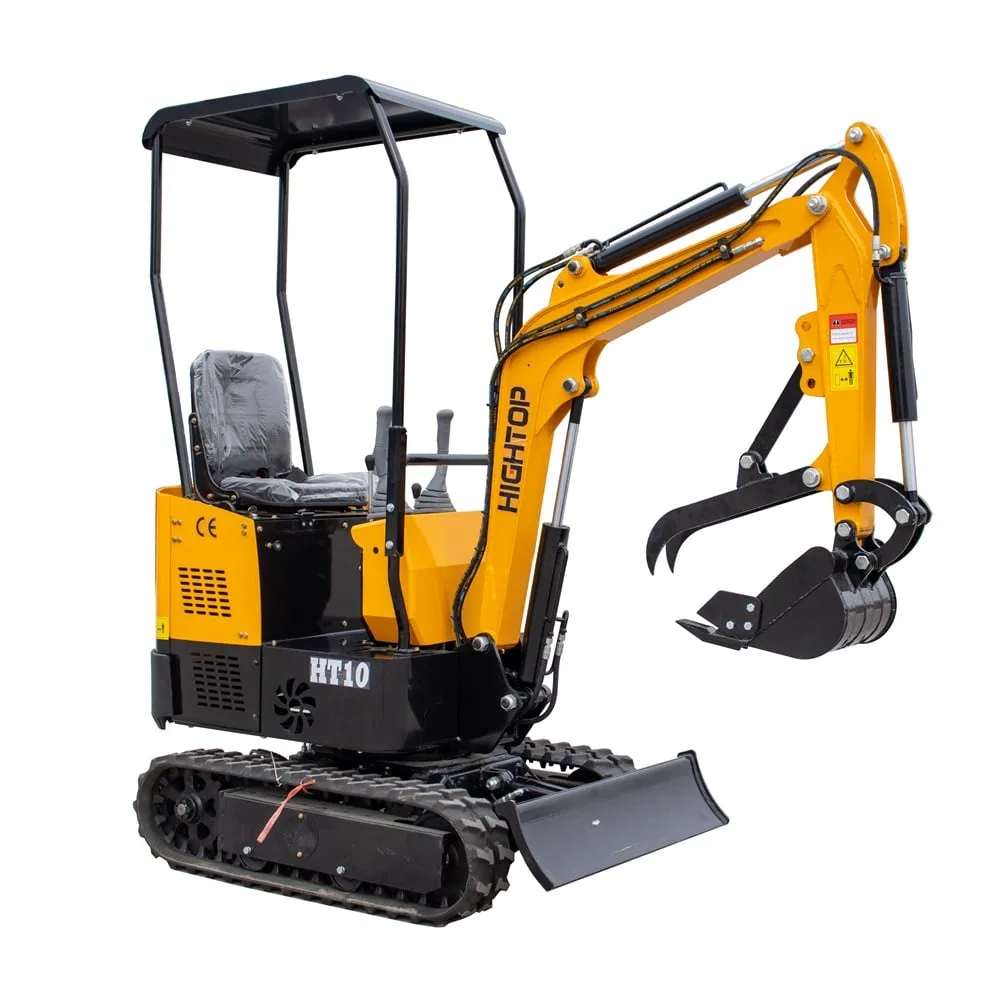
HT10 owner experience is useful—but not always exact HT10B evidence.
HIGHTOP and other sellers use HT10-family names across multiple engines and revisions. The specification sections on this page describe the official KOOP-powered HT10B. The ownership sections synthesize independent HIGHTOP HT10-labelled machines and identify the limits where engine or revision is unclear.
That evidence is strong enough to identify work fit and recurring inspection priorities. It is not a fleet study, a failure-rate calculation or proof that every HT10B will share one owner’s problems.
01 · Exact configuration
Review the HT10B—not every machine called HT10
HT10 is a market cluster as much as a model name. Similar-looking excavators are sold by different companies with different engines, weights, work envelopes and hydraulic components. This review uses the official HIGHTOP HT10B with the KOOP 292F as its specification baseline.
Fix the engine
The official baseline is a 7 kW KOOP 292F air-cooled diesel. Briggs & Stratton and Yanmar are listed as options, but an engine change affects fuel, cooling, vibration, service parts, weight and certification. Put the exact engine model and plate into the order rather than accepting “famous engine” or “KOOP option.”
Fix the chassis revision
The official page lists a 1,000 kg machine, 1,750 mm digging depth and 255 mm blade digging depth. A generic HT10 operation manual lists 950 kg, 1,650 mm and 110 mm. That manual remains useful for system and maintenance guidance, but the dimensional conflict means it cannot be treated as the final serial-specific data sheet.
Fix the hydraulics
Obtain photos and part numbers for the pump, main valve, swing motor, both travel motors and auxiliary couplers. Component names attached to another HT10-family machine do not establish what will arrive in every HT10B. Those identities control future diagnosis and replacement.
Decision rule: Reject a quotation that cannot attach one engine plate, one dimensioned drawing and one hydraulic component schedule to the exact HT10B being ordered.
02 · Job fit
Buy it for narrow-access light excavation
The HT10B's useful case begins where a larger machine cannot enter or where occasional work does not justify a much more expensive excavator. It is a labour-saving property machine before it is a production excavator.
Strong work
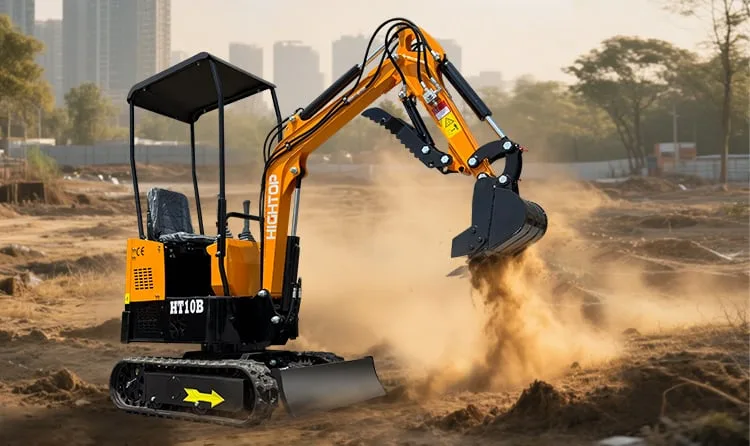
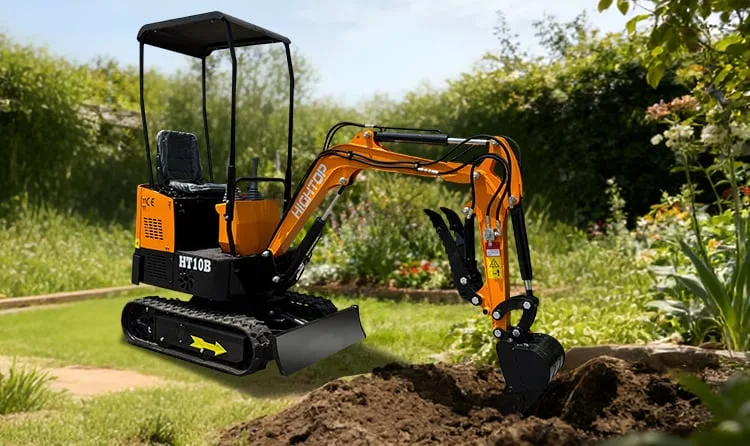
Shallow drainage, irrigation, small utility trenches, garden and landscaping work, loose-soil cleanup, planting, stump exposure, small retaining-wall preparation and moving spoil over short distances fit the class. A narrow bucket, grading bucket, ripper or simple thumb can expand that work when matched correctly.
Slow or difficult work
Dense dry clay, compacted fill, embedded rock, large roots and repeated maximum-depth digging expose the limits of a one-ton machine. A ripper can concentrate force, but it does not add machine mass or cooling. Production falls quickly when every bucket depends on repositioning or working at the edge of the envelope.
Poor work
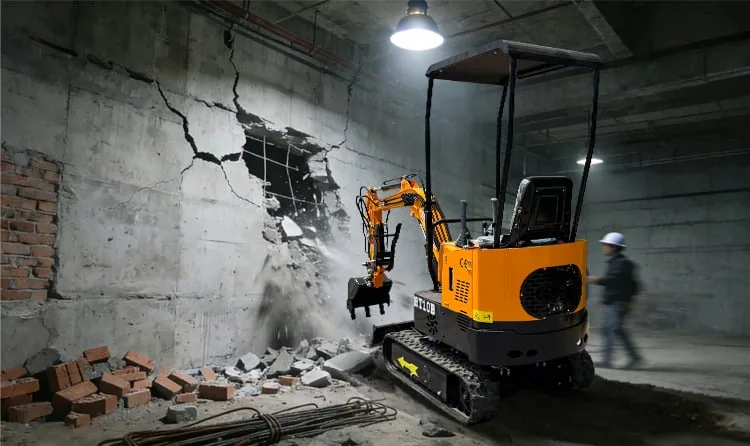
Recurring heavy lifts, long travel cycles, loading tall trucks, demolition with falling-object exposure and daily high-output excavation are weak fits. No configuration-specific lift chart was found, so the HT10B should not be bought around a promised lifting number from a sales chat or demonstration.
Decision rule: Choose it when the normal job is narrow, shallow and intermittent; move up in size when production, hard digging, lift margin or operator protection is the real constraint.
03 · Digging and stability
Its compact footprint is both the advantage and the limit
A 930 mm machine can enter a side passage that excludes many rental excavators. The same narrow stance and low mass reduce the reserve available on slopes, side lifts and extended digging.
Use the blade deliberately
Keep the blade toward the work where the operating plan and manual allow it, lower it onto competent ground and keep loads close. Owners describe the machine becoming light or tilted with larger suspended objects. Hydraulic force can move a load that the chassis should not carry.
Plan the whole route
Measure turns, cross slopes, soft shoulders, steps, overhead clearance and recovery access. The generic manual warns against crossing slopes over 15 degrees, but that is not a target working angle. Wet clay, loose stone and a high attachment reduce the usable margin.
Protect the travel system
At 1.5 km/h, the HT10B is intended to work within a compact area. The manual calls for a five-minute rest after every 20 minutes of long-distance travel. Avoid pivoting repeatedly on high-grip surfaces, keep stones out of the undercarriage and inspect tension before a thrown track damages more parts.
Decision rule: Use the access advantage conservatively: work on firm ground, keep the attachment low during travel and never convert hydraulic capability into an invented lift rating.
04 · Controls and operator experience
Expect basic controls, vibration and close quarters
The retained owner accounts do not describe premium-machine smoothness. They describe a small excavator that becomes productive after the operator adapts to its control speed, lever positions and limited space.
Test combined functions
Do not accept a video that cycles one cylinder at a time. Travel while operating the boom and bucket, slew while grading, and use the auxiliary circuit under load. Watch for engine bogging, valve interaction, delayed movement, cylinder drift and control response after the oil heats.
Check lever layout
One owner found the blade control awkward while driving; another described the work controls as tight but manageable. A third added foot controls. Sit in the exact canopy and operate every function without reaching across a travel lever, rubbing a hose or losing stable foot placement.
Treat the canopy correctly
A four-post roof is not automatically a documented rollover or falling-object protective structure. Ask for configuration-specific certification and labels. Do not buy the open-canopy machine for work where falling material, demolition debris or rollover exposure requires protection it cannot document.
Decision rule: The controls can complete useful work, but the buyer should demonstrate smooth combined operation and a safe seating position before treating the machine as suitable for long shifts.
05 · Engine and hydraulics
Simple systems help only when every component is identifiable
The KOOP-powered HT10B is mechanically straightforward, but simplicity is not the same as local support. The owner still needs filter references, diagrams, hydraulic specifications and a way to handle tropical heat.
KOOP 292F baseline
The 7 kW air-cooled single-cylinder diesel should be expected to sound and feel less refined than a multi-cylinder water-cooled engine. Keep the cooling path clean, use the engine-specific oil and filter schedule, and confirm cold and hot starting. Do not borrow a Briggs or Yanmar service schedule.
Cooling and filtration
One owner wanted a hydraulic cooler and return filter after noticing heat below the seat. That is a single configuration report, not proof of a model-wide overheating defect. It is enough to require confirmation of the cooler, reservoir capacity, suction and return filtration, fluid grade and stable hot-cycle performance.
Auxiliary attachments
An auxiliary line does not prove breaker, auger or hydraulic-thumb compatibility. Record usable flow, pressure, one- or two-way function, return routing and coupler size. Confirm that the engine and cooling system can sustain the intended tool rather than only making it move for a short factory clip.
Decision rule: Buy the component schedule and hot-cycle demonstration with the machine; a familiar engine label does not identify the hydraulic system.
06 · Maintenance and ownership
The ownership model is inspect, protect and repair
The strongest owner accounts are not stories of maintenance-free equipment. They show useful work alongside routine tightening, adjustment, modification and repair.
Fasteners and joints
Perform an arrival torque audit using appropriate values, paint-mark critical fasteners and recheck them after the first operating hours. Inspect boom, arm, blade, canopy, seat pedestal, cylinder mounts and attachment joints. Grease every intended point and correct pins or bushings that cannot receive lubrication.
Tracks and undercarriage
Learn the grease-tensioner procedure before the first job. Check both tracks for equal tension, verify locking hardware, clean packed stone and clay, and inspect sprocket engagement and roller alignment. Obtain the exact replacement track size, grease valve, seals and tensioner parts before importing.
Rain and corrosion
Store the machine under a ventilated cover, keep water out of switches and the hour meter, repair chipped paint, protect connectors and wash salt or fertilizer residue promptly. The manual specifically calls for salt removal and electrical corrosion maintenance in beach conditions.
Decision rule: The HT10B suits an owner willing to establish a maintenance baseline immediately; it is a poor fit for someone expecting to operate until a dealer schedules the first service.
07 · Service and parts planning
Build the support path before the machine arrives
The HT10B makes the strongest case where narrow access and light property work matter. Climate, ground conditions and parts lead times determine how complete the support package needs to be.
Stock the first service
Bring engine filters, compatible oil information, fuel components, hydraulic suction and return filters where fitted, fuses, relays, ignition switch, belts, common seals and spare keys. Add track grease hardware and the hose/fitting schedule rather than a random supplier spare carton.
Map local repairs
Identify a hydraulic-hose shop, diesel mechanic, welder and electrical technician willing to work on the machine. Give them the diagrams and component photos. Confirm which filters, bearings, seals and hoses can be cross-referenced locally and which parts remain supplier-dependent.
Budget downtime
A property owner can often pause a project while a part travels. A contractor with a crew and customer deadline cannot. Include backup rental, express freight and diagnosis time when comparing the HT10B with a used supported machine or local rental.
Decision rule: Direct import works best when ordinary service is local and only machine-specific parts must cross the ocean.
Six detailed owner videos
The operating history behind the review.
These reports cover different engines and HT10-family revisions, so they do not replace the exact HT10B specification table. Together they show the jobs owners completed, the faults they repaired and the checks that repeatedly mattered.
Long-term ownership and repair history
The longest retained report covers a machine still doing property work after carburetor, ignition-coil, hose, seat, hinge, track, hour-meter and fastener repairs. The owner regarded most faults as repairable but would not choose the same ownership model for revenue-critical work.
Watch Trike4lifeTrack tension, weld and service access
This owner remained positive about the machine and reported easy starting, while also documenting a loose track-tension locking nut, a thrown track, a pedestal weld repair and awkward engine-oil service access.
Watch Stevens DIYHomeowner work, finish and support
A detailed early-ownership account shows slope shaping, soil movement and rock placement, then examines loose screws, fading and rust, ignition and throttle details, a seized attachment bushing, a weak grapple and difficulty obtaining useful parts information.
Watch J0VegzTrail-building configuration review
A buyer who had previously rented a Kubota U17 explains why the narrower HT10 suited trail access, identifies the Briggs & Stratton engine, and closely inspects the controls, bucket construction, hour meter, auxiliary plumbing and grease points.
Watch Hartland NorthwestOperating and grading review
This full work demonstration covers driveway preparation and material spreading. It also reveals jerky controls, an awkward blade lever, possible bucket-to-cylinder interference and stones collecting around the undercarriage.
Watch Ven KorControls, attachments and heat management
A modification-focused owner shows manual foot pedals, a quick hitch, lights and a larger cylinder, while raising practical questions about heat below the seat, hydraulic filtration and cooling.
Watch JTs Okie Hobby and AdventuresOwner and operator findings
What repeats—and what remains one report.
The useful signal is not whether one owner liked or disliked the machine. It is which jobs were completed, which maintenance demands repeated, and which claims remain specific to one configuration.
Useful property-scale work
Owners used HT10-labelled machines for driveway preparation, trails, shallow trenching, grading, moving soil and rocks, and general property cleanup. The machine can replace a large amount of hand work when the task fits its small digging envelope.
Basic control refinement
Controls were described as stiff, jerky or awkward in several configurations. Owners still completed useful work, but some changed foot controls, quick hitches, lighting or lever arrangements to make the machine easier to use.
Fastener and joint inspection
Loose screws, backing nuts, damaged or stripped fasteners, a seized attachment bushing and isolated weld or hinge repairs appeared across independent reports. These findings support a thorough torque, pin, grease and weld inspection—not a universal structural-failure claim.
Track retention needs attention
A nine-month owner threw a track after a tension-locking nut loosened. A three-year owner described tracks coming off repeatedly before servicing the tension system. Track alignment, tension, grease adjusters, rollers and sprockets belong in every inspection.
Weather exposure matters
Early rust, paint fading, surface corrosion and exposed electrical failures appeared in more than one account. Covered storage, drainage, dielectric protection, paint repair and salt removal matter even more in a warm, wet or coastal environment.
Support depends on the seller
One owner received a replacement ignition switch; another described slow responses and no useful parts list. The machine should be bought with component identities, diagrams and starter spares already in hand rather than assuming post-sale support will fill the gaps.
That owner kept the machine useful through repairs but would not repeat the purchase for business use because a broken machine stops revenue. One account cannot predict every HT10B, yet it clearly shows why uptime value differs between property and commercial buyers.
Before payment and after arrival
Put the exact machine through this review.
The inspection should prove identity, safe basic function, hot performance and serviceability. Repeat the essential checks after shipping before demanding work.
- HT10B revision, model year, legal manufacturer and serial-number format
- KOOP 292F engine plate, rated output, fuel and engine-specific service schedule
- Pump, main valve, swing motor and both travel-motor identities
- Operating weight, overall dimensions, packed measurements and gross shipping weight
- Configuration-specific digging envelope and lift chart
- Track size, adjuster, grease valve, roller and sprocket part numbers
- Auxiliary flow, pressure, direction, return path and coupler standard
- Hydraulic cooler, suction/return filtration and fluid specification
- Canopy or protective-structure certification and safety labels
- Cold start, combined functions, loaded digging, hot restart and leak inspection
- Torque audit, grease points, pins, bushings, welds and hose routing
- Manuals, diagrams, filter cross-references, starter spares and warranty remedy
Questions buyers ask
HIGHTOP HT10B FAQ
Open each question for the specification, ownership trade-off or inspection step behind it.
01Is the HIGHTOP HT10B a good mini excavator?
It is a useful light-property excavator when narrow access, occasional trenching and a low acquisition cost matter more than production speed and dealer support. Owner reports show real driveway, trail, grading and soil-moving work, but also basic controls and hands-on maintenance. It is not a strong choice for daily commercial uptime, repeated hard digging or lifting without a chart.
02What is the difference between HT10 and HT10B?
The names are often mixed in listings, but they should not be assumed identical. The official HT10B baseline is 1,000 kg with a KOOP 292F, 930 mm overall width and 1,750 mm maximum depth. A generic HT10 manual gives different weight and depth figures. Require the exact model revision, engine plate, dimensioned drawing and hydraulic component schedule.
03How deep can the HT10B dig?
The official HT10B page lists a 1,750 mm maximum digging depth and 2,850 mm maximum ground reach. Those are envelope limits, not guaranteed production depths in every material. Bucket movement, spoil placement and digging force become less useful near the edge of the envelope, especially in dense clay, rock or roots.
04How much can the HIGHTOP HT10B lift?
No configuration-specific lift chart was found, so this review does not give a working lift figure. The 120 kg text shown beside bucket capacity is not a safe lift rating. Capacity changes with radius, height, direction, blade position, ground and attachment. Buy a larger documented machine if recurring lifting is central to the work.
05Which HT10B engine should I choose?
The baseline reviewed here uses the 7 kW KOOP 292F diesel. Briggs & Stratton and Yanmar are listed as options, but the choice changes fuel, cooling, service parts, vibration, price and possibly machine weight. Select from local service access and exact documentation rather than the engine name alone.
06Does the HT10B have common track problems?
Two independent longer-use HT10 owners described thrown or repeatedly displaced tracks associated with tension or locking hardware. That supports careful track-tension, adjuster, roller and alignment checks, but it does not establish that every HT10B will throw tracks. Correct setup, terrain, turning technique and maintenance all matter.
07Does the HIGHTOP HT10B overheat?
One owner of an HT10/HT10B-style machine noticed heat below the seat and wanted a hydraulic cooler and filter. That single report cannot establish a model-wide overheating problem. Confirm the ordered cooler and filter arrangement, clean airflow paths, correct fluid and demonstrate repeated combined work until fully hot.
08Can I use an auger, breaker or hydraulic thumb?
Only after matching the attachment to the exact auxiliary flow, pressure, direction, return path, case-drain need, couplers and cooling limit. Some owner machines arrived with thumb plumbing or were later modified. The presence of two hoses is not a compatibility specification.
09Is the HT10B suitable for commercial work?
It can perform small paid jobs, but the ownership evidence does not support a daily-commercial uptime promise. The three-year owner said it was useful for property work but would not repeat the choice for a business because repairs create lost time. Commercial buyers should price local support, backup rental and parts delay against the lower purchase cost.
10What should I inspect when the machine arrives?
Match serial and component plates to the order, check every fluid and filter, torque critical fasteners, grease every joint, inspect welds, pins, bushings, hoses and wiring, set track tension, and test safety devices. Run a cold-to-hot cycle using combined functions and every attachment, then recheck leaks, temperatures, fasteners and tension.
11Should I import the HT10B directly or buy from a local dealer?
Compare the same engine and attachment package at the same delivery point. Direct import may reduce acquisition cost but transfers freight, commissioning, documents, parts and warranty coordination to you. A local dealer is worth more when it stocks relevant components, diagnoses faults and provides a written labour and parts remedy.
12What spare parts should I order with it?
Start with engine and hydraulic filters, fuel components, fuses, relays, ignition switch, seals, common hoses or a complete fitting schedule, track grease hardware and service fluids. Add replacement track specifications, pins, bushings and attachment wear parts. Build the package from the exact serial configuration rather than accepting generic free spares.
Sources and next steps
Technical documents and retained owner reports.
- HIGHTOP HT10B technical page
- HT10 operation and maintenance manual
- Trike4life — 3 years review of my Chinese excavator digger, Hightop HT10
- Stevens DIY — HT-10 Chinese mini excavator 9 month review
- J0Vegz — Hightop HT10 1 Ton Mini Excavator Review by Homeowner
- Hartland Northwest — HT10 with Briggs & Stratton review
- Ven Kor — HIGHTOP HT10 operating review
- JTs Okie Hobby and Adventures — HT10 modifications with manual foot pedals